Fast thermal equilibration and control protocols in colloidal systems – An analytical and machine learning approach
Doctorate Thesis in Physics, Universidad de los Andes (2026)
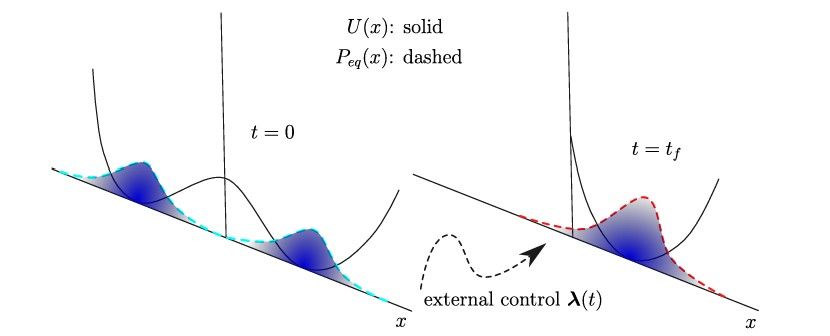
Mesoscopic systems, such as colloidal particles, molecular motors, and nano-electromechanical devices, operate in a regime where thermal fluctuations are significant and finite-time effects cannot be neglected. In these systems, quasi-static transformations—which assume infinitely slow changes to maintain equilibrium—become impractical. This thesis addresses the fundamental challenge of rapidly driving mesoscopic systems between equilibrium states in times shorter than their natural relaxation timescales, a problem central to the field of shortcuts to adiabaticity (STA) in stochastic thermodynamics.
We focus on systems governed by the overdamped Langevin equation in contact with a thermal reservoir. Our approach combines analytical theory, stochastic simulations, and machine learning techniques to design optimal control protocols that accelerate thermal equilibration. The thesis presents three main contributions:
First, we develop analytical solutions for fast thermal equilibration in harmonic potentials. We introduce the two-step protocol (TSP), which achieves equilibration in finite time and admits closed-form expressions for the probability distributions of work, heat, and entropy production. These exact results provide nontrivial examples that satisfy fundamental fluctuation theorems, including the Jarzynski equality, the Crooks fluctuation theorem, and the entropy production fluctuation theorem. The TSP also serves as a benchmark for evaluating numerical optimization methods.
Second, we implement a machine learning framework based on automatic differentiation and stochastic gradient descent to discover shortcut protocols for systems with arbitrary potential energy landscapes. This approach uses differentiable parametrizations of control protocols and leverages GPU-accelerated simulations to efficiently compute gradients. We demonstrate the method’s versatility by optimizing protocols for both harmonic and anharmonic (quartic) potentials, comparing performance against analytical benchmarks and showing robustness under variations in protocol duration and system parameters.
Third, we investigate relaxation dynamics in complex potential landscapes, specifically the tilted washboard potential with multiple minima. This study explores the transition between locked and running states and dynamical phase transitions.
Throughout this work, we employ the framework of stochastic thermodynamics to quantify the thermodynamic variables at the trajectory level. The methods developed here are applicable to a broad class of experimental systems, including optical tweezer experiments, microscopic heat engines, and micro- and nano-fluidic devices. By bridging analytical theory with data-driven optimization, this thesis contributes to the modern toolbox for controlling mesoscopic systems and demonstrates the power of combining physics-based modeling with machine learning techniques.