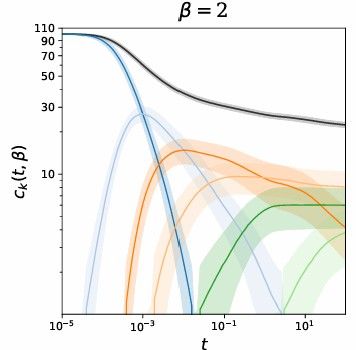
Log-gases provide a unifying framework for studying collective phenomena in two dimensions, where the interactions between their constituents take a logarithmic form [1, 2]. These types of gases arise in classical plasmas–where vortex matter and quantum Hall droplets exhibit logarithmic interactions–and in the eigenvalue distributions of non-Hermitian random matrices [3], whose eigenvalues behave as point charges repelling each other through a logarithmic potential. We study the dynamics of a Log-Coulomb gas consisting of N charged particles confined to a unitary circle and coupled to a thermal bath characterized by a dimensionless effective parameter β = q0²/(kBT) where q0 is the charge per particle, T the bath temperature, and kB the Boltzmann’s constant. Using a free-fermion model at β = 2, we obtain an analytical expression for the two point correlation function in the simplest case N = 2, and then extend our analysis to N > 2 both numerically and analytically. By varying β, we show that a logarithmic time-law scaling governs the time evolution of this process, and we verify the validity of Wigner’s surmise for β ≥ 1 by comparison with the corresponding Gaussian ensembles for times larger than the relaxation time, τ ≥ τEq, i.e., once the system has reached thermal equilibrium. In addition, we analyze the out-of-equilibrium dynamics of the Log-Coulomb gas in the presence of fusion events among the particles [4]. Starting from unit charges (q0 = 1) and N0 = 100 initial particles, we introduce a new parameter, the fusion length lf, which allows us to control the spatial region where fusion events occur during the simulations. For this new dynamics, the onset time of cluster formation and the maximum cluster population follow a behavior given by ln(t′) ∼ βebk. Finally, using the random matrix formalism we endow the elements of a random matrix drawn from the Gaussian Unitary Ensemble with a Dyson Brownian motion dynamics. We initialize the dynamics of the eigenvalues with all of them lumped at the origin, but one outlier. We solve the dynamics exactly which gives us a window on the dynamical scaling behavior at and around the Baik-Ben Arous-Péché transition. Amusingly, while the statics is well-known and accessible via the Hikami-Brézin integrals, our approach for the dynamics is explicitly based on the use of orthogonal polynomials.
Universidad de los Andes | Vigilada Mineducación
Reconocimiento como Universidad: Decreto 1297 del 30 de mayo de 1964.
Reconocimiento personería jurídica: Resolución 28 del 23 de febrero de 1949 Minjusticia.