Preparation of the initial state and its advantages in quantum thermal machines
Master Thesis in Physics, Universidad de los Andes (2025)
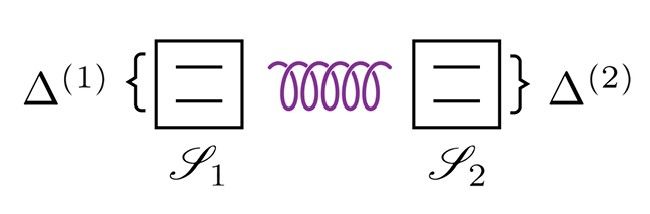
Recently, there has been significant interest in extending thermodynamic concepts—particularly thermal machines—into the quantum regime to better understand the exchange of physical quantities such as energy and information between a system and its environment. In this thesis, we present the theoretical framework necessary to develop the concept of a quantum thermal machine from a quantum mechanical perspective. Leveraging these tools, we propose a two-qubit system, which can be prepared either in a separable state or a correlated state, and subject it to a thermodynamic cycle by immersing the system in an environment while externally controlling its energy gap Δ. We evaluate the performance of the system in both configurations under ultra-weak and weak coupling regimes, employing an endoreversible cycle and dynamics governed by a Lindblad master equation, respectively. Our findings show that the efficiency η exhibits similar behavior in both regimes, indicating potential for optimization through correlations. However, the power output P displays distinct behaviors across the two regimes, attributed to the specific protocol applied in the weak coupling scenario. Despite this difference, our results suggest that correlations offer opportunities for enhancing efficiency and power in quantum thermal machines.