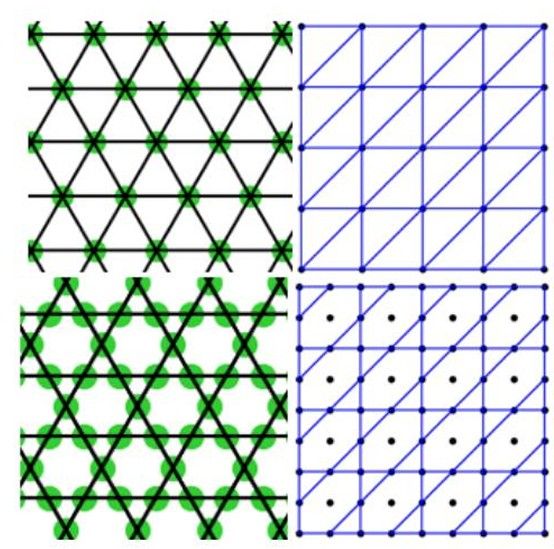
Monte Carlo Study of Residual Entropy and Topological Modifications in Frustrated Ising Lattices
Undergraduate thesis in physics, Universidad de los Andes (2025)
This study explores how variations in lattice topology and spin interactions influence the residual entropy and ground-state degeneracy of frustrated Ising magnetic systems. A computational framework combining graph-based lattice construction, Metropolis Monte Carlo sampling, and thermodynamic integration is applied to the triangular and kagome lattices as reference frustrated geometries. The analysis is then expanded to controlled and random modifications of lattices and to different spin interactions.
The method reproduces the known residual entropies of the undiluted triangular and kagome antiferromagnets, establishing confidence in the numerical approach. Random de fects, introduced through site and bond dilution, consistently suppress residual entropy by relieving frustration. In contrast, controlled periodic defects in the stitched kagome constructions demonstrate that degeneracy can be modified in a structured way, with short stitch periods preserving frustration and longer periods producing an oscillatory but overall decreasing trend in residual entropy. The behaviour of different stitch orientations reflects both the rotational symmetry of the kagome lattice and finite-size effects associated with the square embedding.
Further analysis of interaction anisotropy and next-nearest-neighbour couplings shows that frustration remains robust near the isotropic limit but is progressively reduced when additional constraints are introduced. Increasing anisotropy or next-nearest neighbor interactions lowers the number of compatible ground states, decreasing residual entropy. All together, these findings show that residual entropy in frustrated Ising systems is highly sensitive to connectivity, defect engineering, and interaction competition. The results provide a coherent picture of how degeneracy can be controlled through structural or interaction based modifications, offering a basis for future work involving experimental realizations of frustrated metamaterials.