Spin glass dynamics on complex hardware topologies: A bond-correlated percolation approach
Phys. Rev. Research 8, 033099 (2026)
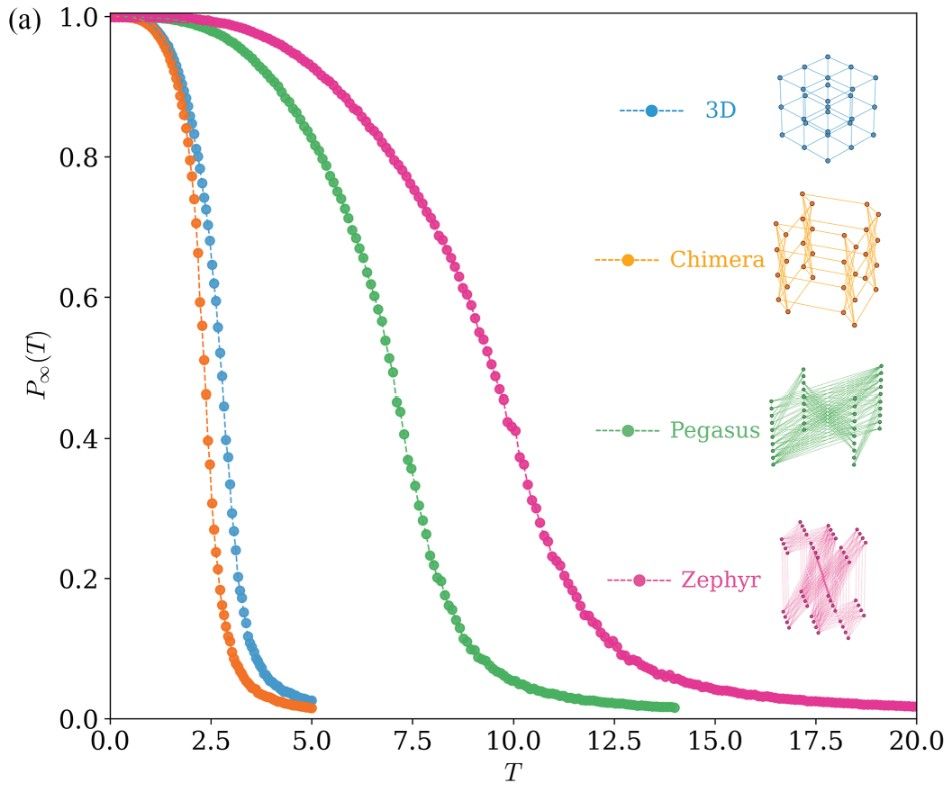
Understanding how frustration and disorder shape relaxation in complex systems is a central problem in statistical physics and quantum annealing. Spin glass models provide a natural framework to explore this connection, as their energy landscapes are governed by competing interactions and constrained topologies. We investigate the nonexponential relaxation behavior of spin glasses on network architectures relevant to quantum annealing hardware—such as finite size Chimera, Pegasus, and Zephyr graphs—where embedding constraints and finite connectivity strongly modulate the distribution of barriers and metastable states. This slow relaxation arises from the combined effects of frustration and disorder, which persist even beyond the conventional spin glass transition. Within the Fortuin-Kasteleyn-Coniglio-Klein cluster formalism, the appearance of unfrustrated cluster regions gives rise to multiple relaxation scales, as distinct domains follow different dynamical pathways across a rugged energy landscape. This framework enables a broader characterization of spin glass energy landscapes and provides physical insight into how topological constraints, frustration, and disorder jointly govern relaxation dynamics in complex networks relevant to quantum annealing architectures.